
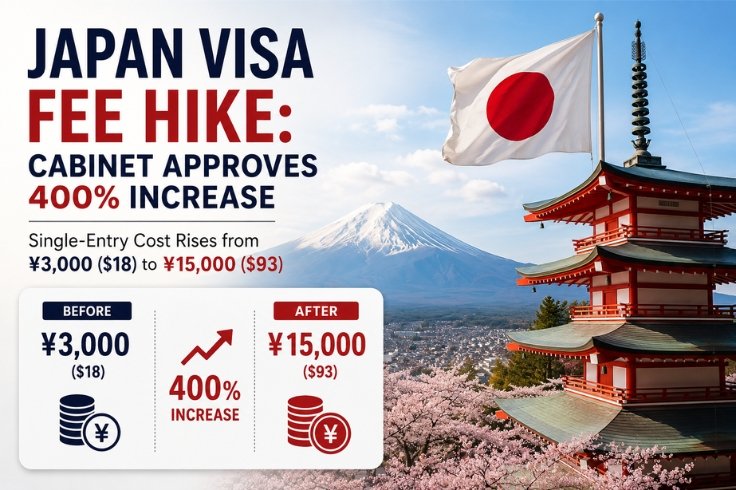
Japan Visa Fee Hike: Cabinet Approves 400% Increase, Single-Entry Cost Rises from ¥3,000 ($18) to ¥15,000 ($93)
Here are the details of the increase and your options if you wish to travel to Japan in the next few years.
How Much Will You Pay?
Effective immediately (1st July 2026), Japan’s new visa prices apply to ALL nationals applying for Japanese visas. Below is a breakdown of the visa types and their respective prices before and after the increase:
- Single Entry: 3,000 yen (~$18) to 15,000 yen (~$93)
- Multiple Entry: 6,000 yen (~$37) to 30,000 yen (~$186)
Essentially, this is a 500% increase for both the single and multiple entry visas. If you submit your visa application before 1st July, then you will only pay the old fees.
This isn’t the only thing that announces an increase in Japan’s visa fees; it’s also about timing. For 43 years, from 1978 to 2021, there were no changes to Japan’s visa fee schedule. For context, this corresponds to the same year when the eventual co-founder of Studio Ghibli, Hayao Miyazaki, was still directing for TV and long before Japan was a bucket list destination. Finally, after nearly 50 years of inflation (and a much weaker yen), the total cost of getting into Japan is reflecting several factors, such as inflation, exchange rate changes, and rising costs associated with visiting Japan.
Toshimitsu Motegi (the Foreign Minister for the Government of Japan) confirmed the updated fee structure at a press conference, explaining that it was past due; therefore, it was not intended as a punishment. Additionally, he stated that the increase will reflect both the inflationary increases in the exchange rates during the last 43 years as well as the government does not expect the new fee increases to negatively impact inbound tourism business in the short term.
The panic surrounding higher fees charged by Japan to travelers is overshadowing the larger story: most travelers from Western countries will not be impacted at all.
Japan is preparing to sharply raise visa fees in its largest increase in almost half a century, with the new rates to take effect from Wednesday (July 1, 2026), to cover rising immigration system costs as the number of tourists and foreign nationals entering the country continues… pic.twitter.com/Gf3gDAI5w8
— Thenationthailand (@Thenationth) June 23, 2026
The new fee increase will only affect those not already eligible to receive a visa waiver from Japan. Citizens from many countries, including those in North America, the United Kingdom, Australia, New Zealand, EU member nations, South Korea, and Singapore, are all eligible to receive a 90-day visa waiver for tourism purposes and as such will not be subjected to the new fee increases unless they stay for longer than 90 days, or travel for a non-tourist reason (e.g., business or education).
There are many countries left out of the visa waiver program including Russia and a good portion of the Middle East and Africa. However, the most important destination to Japan’s tourism economy that isn’t eligible for the program is China. China has been consistently one of Japan’s highest sources of inbound visitors over the years, so this single decision will affect a large portion of the tourism market while many of the “Japan travelers” on Instagram are totally untouched.
India has been impacted too, though it’s a market that Japan has been courting aggressively. The Indian travel press has been monitoring this change closely, indicating that, the new prices mean that Indian travellers and other visa-required nations will need to consider the new prices in their travel budgets, but the overall attractiveness of Japan — cherry blossoms, bullet trains, food, mix of ancient temples and neon cities — still draws people there.
The final source country affected by the increase is Vietnam. The new structure covers a total of more than one hundred different countries.
Why Now? The Real Story Behind the Increase in Visa Charges
This is about catching up to inflation, but there’s also been a second-side storyline that nearly every travel writer discusses – Japan is facing a reckoning regarding overtourism.
Japan experienced a record-breaking number of foreign tourists in 2025, with over 42.6 million visiting that year alone – a truly astonishing statistic considering the size and scope of Japan’s population and infrastructure. The strong yen made it very economical to visit Japan as a foreign tourist, and foreign tourists took advantage of this fact. Gion in Kyoto had previously been able to remain predominantly traditional but felt like a theme park with many foreigners instead of the locals traditionally associated with the area. The subway system experienced tremendous crush loads due to large amounts of tourists visiting Tokyo and taking lots of photographs of long bus lines in Shibuya and Asakusa that gained notoriety via social media during the summer months. Areas around Mount Fuji, Hokkaido’s ski resorts, and many cities throughout Japan began to complain about things such as excessive road usage, no available garbage collection, and inadequate public transportation systems designed to accommodate large numbers of visitors.
As a result, Japan has begun utilizing every available resource to deal with these issues. The fee increase for obtaining tourist visas to Japan is only one small part of this large effort to make necessary changes in the travel industry in Japan by the end of 2026.
- The latest increase in the farewell tax, commonly known as the “sayonara tax,” saw its price tripled for leaving the country – from Y1,000 to Y3,000 on July 1st, 2021. This charge applies to everyone, including Japanese citizens and people with short-term, long-term, working, or otherwise non-regular visas.
- Kyoto also saw an increase in hotel tax, which went vertical on March 1st, 2026, when it endorsed a 5-tiered lodging tax schedule; currently, the highest lodging tax in Japan at per night stays and up to Y10,000 per person per night (a tenfold increase over the previous cap of Y1,000).
- The trend of local lodging taxes has rapidly spread (i.e., dozens of municipalities from Sendai to Okinawa) as those communities have endorsed new hotel/motel taxes based on per-night lodging use.
- Two-tiered, dual pricing programs are under consideration by national authorities. Himeji Castle charges non-residents Y2,500 compared to residents’ Y1,000 for admission fees. The Japanese Ministry of Land, Infrastructure, Transport, and Tourism is working on national guidelines to help establish two-tier pricing on attractions throughout the country.
All of these incidents or situations are not random occurrences, but rather they reflect an overall picture of a government wishing to maintain tourist revenue while making tourists pay a higher portion of how they impact our infrastructure, housing, and daily life to our residents.
Where Your Money Goes
The Japanese Ministry of Foreign Affairs states that just with the increase in visa fees alone, it’s projected to produce around 116.1 billion yen (approximately $19.7 million USD) in additional revenue for the 2026 fiscal year. This is not a small amount of money, but it is a fraction of all the additional revenue that the other parts of the overtourism toolkit, i.e., departure taxes, hotel levies, attraction surcharges, will be generating.
Officials have been fairly consistent in describing the intended use of these funds, including: Digital congestion monitors; Multilingual staff at over-crowded sites; Waste management improvements in tourist-heavy districts; Preservation of historical sites; Marketing campaigns aiming at displacing tourists away from the over-crowded areas in Japan, referred to as the “Golden Route” of Tokyo-Kyoto-Osaka, to quieter places within Japan.
The way that funds will ultimately be used for reinvestment is where those concerned are going to focus their attention. It’s one thing when fees are raised for infrastructure and it’s quite different to verify the improvements one year after they’ve been implemented.
This Is A Broader Discussion Than Just Visa Fee Increases
The legal jurisdiction granted by the government to administer increases of additional types of charges in addition to tourist visa fees added complexity to this discussion and should have long-term residents and expatriates concerned regardless of the impact tourist’s fee increase will have on their travel plans.
The new law, which allows for the increase of tourism visa fee increases, will now allow for changes in residence status and visa renewals of up to 100,000 yen instead of 10,000 yen before now, and an increase in the all-time maximum permanent resident application fee maximum will now be up to 300,000 yen instead of 10,000 yen before now.
The ceilings shown in these tables are not final; the actual figures will be determined later by Cabinet decisions and public consultation. However, the government proposed early on what to expect in terms of future fee ranges. Therefore, while there is still uncertainty about fees for long-term residents, they could range from ¥ 10,000 to $70,000 depending on how long an individual has held a lawful status for renewal. For those applying for permanent residency, there may be an estimated fee of around ¥200,000, which is the equivalent of 20x the current fee; all new fees are anticipated to go into effect prior to March 31, 2027 (the end of Japan’s fiscal year 2026).
Thus, the Tourist Visa headline is the most powerful aspect of this article but is also really only one small part of a much larger revision of immigration fees.
What to Anticipate: JESTA
Don’t get too comfortable as a visa-exempt visitor; those of you who’ve enjoyed this privilege so far may have to change your thinking… Japan is going to introduce an electronic travel authorization known as JESTA (Japan Electronic System for Travel Authorization), similar to the United States’ ESTA and Europe’s ETIAS travel authorizations, anticipated for introduction sometime in 2028. It would apply to people who currently have a visa exemption (such as US citizens, UK citizens, Australians, and those from all other countries who fit into the 90-day exemption category) and will require some sort of pre-arrival screening and most likely will also incur a fee (although unlikely to be significant). The introduction of JESTA is not necessarily going to negate the existing Visa Exemption Agreements, but will likely create a new definition for “visa-exempt” to mean that ‘visa-exempt’ does not mean ‘no paperwork’ for the second half of the decade.
Effective immediately (1st July 2026), Japan’s new visa prices apply to ALL nationals applying for Japanese visas. Below is a breakdown of the visa types and their respective prices before and after the increase:
- Single Entry: 3,000 yen (~$18) to 15,000 yen (~$93)
- Multiple Entry: 6,000 yen (~$37) to 30,000 yen (~$186)
Should This Change Your Travel Plans?
For most Western nationals who read this, in all honesty, no. If you are American, Canadian, British, Australian, or from most of the countries in the EU, you will continue to enter Japan with an existing 90-day exemption without the requirement of paying a single yen for a visa fee. The increase in departure tax will add an additional couple of thousand yen in cost on the way out, which is roughly equivalent to $13-$20 US dollars, which is noticeable but will not significantly alter your plans to visit Japan.
If you are traveling from China, India, Vietnam, or other countries that require a visa, the numbers change a lot. A visa fee increase from $18 to $93 for a single entry is a lot of money (especially when each member of a family is applying for multiple visas), but it does not make Japan impossible to travel to. But it does put one more expense into your overall budget when traveling there, just as you would account for the checked-bag fee or visa fee with any other country that requires one.
Japan’s tourism economy has changed significantly. The Japanese government, which had worked for many years to increase foreign travel to Japan, is now struggling to deal with the effects of its success. Japan has recently raised visa fees, tripled departure taxes, and raised hotel taxes in Kyoto to new levels. The result is that Japan will no longer be “very affordable” compared to other countries, as costs outstrip the original price of visiting Japan.
For those who plan on visiting Japan in 2026 or beyond, I recommend that they follow Japan’s changes by adding these costs into their trip planning. Just as you would check visa requirements for any country, you should do the same with any potential increase in prices. Tourism based around cherry blossoms, ramen, bullet trains, and temples will continue over the next several years; therefore, the only thing that will have changed is the price of those experiences in Japan compared to other countries.